Saturday, March 25, 2017

Fourth Sunday of Lent 2017


Readings can be found here. 

I used the Long Form this week.

Image result for asking all them questions
Original Video: "Why You Asking All Them Questions"
by Spoken Reasons on YouTube
As I was going through the readings for this week, I thought, "Gosh, everyone is assuming!" I don't know if any of you guys remember that hilarious video from 2012 depicted in that picture, but that was what came to my mind....and then I watched it because #nostalgia. But, seriously, the Pharisees, the disciples, and even the prophet Samuel are making some serious assumptions!

In the First Reading, we hear about God choosing David to be His chosen king for Israel. This story is pretty well known: Samuel goes to see a guy named Jesse because God told him that one of Jesse's sons will be the king. So Jesse shows Samuel seven of his sons, who are all very handsome and impressive looking, and Samuel jumps the gun on especially the first son, but none of them are it. Plot twist, Jesse's youngest and eighth son is tending to the animals, and, despite his relative stature, God hits the golden buzzer. Save God's explanation on how He sees versus how man sees--it'll come back up later.

Next, in this week's Gospel, both the disciples and the Pharisees commit the complex question fallacy (also called "loaded questions"). A complex question is one where a controversial assumption is embedded into the question being asked, "controversial" here meaning "disputed" or "not previously established." An example, to stick with Spoken Reason's video, could be when the girlfriend asks, "You been where? With who?" The assumption embedded in the question is that the boyfriend went somewhere with someone. The dangers of committing the complex question fallacy is that they control the flow of the discussion towards the bias of whomever asked the question--in the prior example, a "yes" will lead down an accusation of cheating, which leads to a fight; on the other hand, a "no" will lead to a demand of proof and the boyfriend's perceived violation of privacy, which also leads to a fight. Either way, guys, you're screwed, so good luck. (The irony is that this example embeds its own assumption. Can you spot it?) Keeping in mind what complex questions are, let's look at the examples within the Gospel.

First, the disciples' question: "Rabbi, who sinned, this man or his parents, that he was born blind?" The assumption here is that someone had to have sinned bad enough that God's wrath was invoked to punish the blind man. Next, the Pharisees ask two complex questions: 1) "You were born totally in sin, and are you trying to teach us?" and 2) "Surely we are not also blind, are we?" The former question embeds the assumption that the Pharisees were not born totally in sin, while the latter embeds the assumption that the Pharisees can see--the "surely" sells this, in addition to Jesus exposing the irony in their question. The disciples' question pales in comparison with these two; at least we can take the disciples as curious. What is the problem with all of these questions? They seek to understand something else other than their own situation.

I think you all know it at this point, but I love me some St. Paul--he knows what he's talking about. This week, he writes to the Ephesians about being children of God, or children of the light. Particularly the first sentence, "You were once in darkness, but now you are light in the Lord," illustrates for me the juxtaposition between a child of light and our three readings, especially the Pharisees. What the Pharisees got wrong is that man, including themselves, actually is born in the totality of sin, making us blind. According to St. Paul here, it is through rejecting the works of darkness and trying to learn what is pleasing to God that we will attain the light of Christ. However, emphasis on "trying" because, being born in the totality of sin, we're bound to mess up; therefore, the next part is exposing the dark to the surface whenever it creeps into our lives (Confession, anyone?). 

Therefore, stop asking about someone else, stop making statements, and stop assuming. Start looking inwards, start exposing your darkness, and start trying to walk the path of God. Start seeing as God sees: Within the heart, specifically, your own. The Lord is our shepherd; there is nothing we should want but His Light. Therefore, "awake, O sleeper, and arise from the dead," for "whoever follows me will have the light of life." (Eph 5:14, Jn 8:12)

Saturday, March 18, 2017

Third Sunday of Lent 2017

Readings can be found here. 

(I am using the long form for the Gospel.)

My "Player Jesus" meme
Generated via memegenerator.net
This week, it seems like the theme is water, and I have to admit: It's ironic for me. This past week, I was just thirsty. All. The. Time. And, of course, I had every sexy symptom that comes with thirst, including dry lips, a dry mouth, and a scratchy throat. We all know how important water is--besides the fact that we need it to survive, it keeps our skin glowing and smooth. Yet, we often avoid drinking water for whatever reason and fill our bodies with junk that can be used to clean toilets! (Coke, I'm looking at you.) Why?! Why do we do that to ourselves??
I think it has something to do with the "taste" of water. We fill our bodies with all this crap that when we finally get to the stuff that's actually good for us, we start grumbling and complaining: "It doesn't taste like anything!" "It tastes like my spit!" "It tastes like old plastic!" What do we do after that? Fill our bodies with more crap.

It seems that the Israelites were doing just this in our first reading. We see throughout the exodus that the Hebrews always have something to complain to Moses about, and, this week, it's water. They filled their minds with all this crap that life in Egypt was better, specifically mentioned in Exodus of the meals and water that they didn't have to worry about. Then, when they get to thoughts of God (Who, in our analogy, is water), they complain with thoughts, particularly, about where He is, if He even loves them, or even if Moses was playing them all along. Thus, they either openly complain about it or secretly take in more soda, AKA the thoughts of Egypt.

Yet, later, in Psalm 81, we find that God was testing them there at Meribah, leading us to our Psalm for this week: "If today you hear his voice, harden not your hearts." If we maintain the analogy of God and His Word being water (Which, philosophy input here, the pre-Socratic philosopher Thales believed everything is water. I'm probably stretching here, but coincidence?), and water is a natural thinner (like, opposite of food thickener), then we can hold that the Word of God can thin/soften our hearts. That's the easy logical conclusion. But what are the implications of this? Well, if we're a hydrophobic substance, then we're not going to very well be inclined to accept that Word. So how do we go from being hydrophobic to hydrophilic?

I think, as we find in this week's Gospel, it is about asking the right questions and being open to, first, finding out what those questions are; second, to continue to desire both the questions and the answers that might be found; and, third, to be open to have those answers changed. (This might sound Gnostic, but hear me out here.) Take a look at the woman at the well and contrast her to the disciples. While she may be slightly hesitant at first--most likely due to societal boundaries--she continues to probe Jesus with questions, eventually arriving at Mark's secret, which is that Jesus is the Christ. Obviously John isn't too worried about Mark's secrecy motif, but, in this passage, he sure keeps the disciples ignorant because John clearly states that they were amazed, yet they didn't ask questions. Of course, not taking that first step is going to hinder a person from achieving the other two in order to be hydrophilic, so let's keep exploring the Samaritan woman.

To the second step, clearly the woman has to be wondering who Jesus really is at some point. Yet she is unafraid to continue to probe Jesus without having the answer to that question just yet. She has to be wondering where to get the living water Jesus is talking about, yet she continues on the dialogue without having the answer to that question, hoping more questions will lead her closer to the answer.

As the dialogue continues between Jesus and the Samaritan woman, she reaches our third step eventually comes to a point where she stops asking questions and, instead, begins to posit what she knows: "Our ancestors worshiped on this mountain; but you people say that the place to worship is Jerusalem" and "I know that the Messiah is coming...when he comes, he will tell us everything." This leads to the third step because she has her whole understanding changed here. Jesus tells her that neither Jerusalem nor the mountain is the place to worship and that he is indeed the Messiah. Finally, after all of this, she seems like she finally has the answers....right? Well, in this story, sure. But, of course, humans have this bad habit of dying, and we all know the man Jesus eventually dies. So, the question turns into "What now?"

Well, shoot, this is where I'm at an impasse because I don't have an answer. Sure, we know the story continues, yet we're still here and Christ hasn't come back; in the meantime, many of our friends have fallen away from the faith or just don't really try, and sometimes we join in with them and take a day off from "this God stuff."

And yet, as St. Paul reminds us in our second reading, it's one thing for a person to find the courage to die for another good person; it's another, harder thing for a person to find the courage to die for a sinner. This proves to us the love of God: We're willing to take in the Coke every once in awhile, but despite that, He still loves us enough that He died for us. That's why the theological virtues--faith, hope, love--are so significant. Last week, I talked about faith. This week, I think the theme is love. God loves us always. It is we who grumble and complain about it. Let us not be like the Hebrews at Meribah who grew stony hearts; instead, let's allow the Lord to soften our hearts like He did with the Samaritan woman. It's okay to be curious, ask questions, and be open. This is where we become hydrophilic. Through our curiosity and, hopefully, eventual understanding of God's love, may we reject the Coke the world offers us and come to love the Living Water, which is everything.

Sunday, March 12, 2017

Second Sunday of Lent 2017

Readings can be found here.

Image result for bossy
PC: Entrepreneur
When I first went through these readings, I thought that God was having us be a little on the lazy side: "Our soul waits for the LORD" in the Psalm and God's whole dialogue to Abram in the First Reading come to mind. It took awhile though, but I've come to the conclusion: God is pretty bossy this week! 

Now, this week is probably where I'm going to drop some philosophy: How can humanity be truly free when passages such as "He...called us to a holy life, not according to our works, but according to his own design" are out there? Even if we are free, are we not just slaves to God? John Milton expressed it best: "Better to reign in Hell than to serve in Heaven." 

Yet, as we see this week in our Lord's Transfiguration, He doesn't yank the three up to their feet or force them up in any way; rather, He "came and touched them." Touched. That sounds rather gentle, not forceful. But maybe this is too strong of an example; after all, I'm sure that if we saw the Transfiguration, we'd be pretty hyped about that too.

Let's take it back to the First Reading. Danish philosopher Søren Kierkegaard really focused on Abraham, and one of his key points regarding our dear father in faith is the fact that, while the Bible portrays a one-on-one conversation, in fact, neither Sarah nor Isaac actually encounter God. This leads to the question: What makes Abraham the father in faith rather than a madman? For Kierkegaard, this depicts that fine line as to what faith really is: Faith causes "fear and trembling," the name of one of Kierkegaard's books; faith transcends the world we know. Man's existential aim is transcendence.

I think, now, our Lord's Transfiguration is not such a hard example anymore. His Transfiguration is our aim, an aim possible only through faith. For those of you who hate "faith" as an answer: Believe me when I say that I'm with you in that boat. But that's kinda the point of faith. If you're giving a person who really hurt you a second chance, you're taking a leap of faith; if you're asking that stellar girl/breathtaking guy out, that's a leap of faith; picking an academic/career plan is a leap of faith. All three of these things induce fear and trembling. Faith is not easy--it's not supposed to be. So, then, how the hell do we do this? Why take me around in a circle, Kevin?

The passage I used from St. Paul to reference God as "bossy" explains this perfectly, I think: A calling is not a command. Rather, a calling is simply an invitation. The Lord is simply inviting us to live that "unique" (holy) life, that "special" life. If it's special, then it's not a life designed by man, but, rather, it is modeled by our Lord. But, of course, anything divine is difficult--nay, impossible--for us mortals. And I think we forget this about faith and Christianity sometimes: It's not easy--it's not supposed to be. If it's easy, you're not doing it right. I don't think I'm being judgmental here, either; St. Paul calls us to "bear [our] share of hardship for the gospel." In fact, he often talks about his own hardship--his "thorn in the flesh." But we're not alone in this endeavor though: We bear this hardship "with the strength that comes from God."

If I lost you in all of that philosophy, I'll use this paragraph to sum up my main reflection in three points. First, I think that this week is introducing to us part of what it means to live a Christian life, in that this life induces fear and trembling. Second, God is inviting us to live this life--He doesn't command us to it. (That's kinda part of the whole "free will" package.) Finally, "our mission, should we choose to accept it," will not be an easy one. It will require the grace and strength of God; it will require us to "listen to him." Then, as we pursue our Christian journey, when we look up, hopefully, we will see no one else but Jesus alone.


Saturday, March 4, 2017

First Sunday of Lent 2017

Readings can be found here


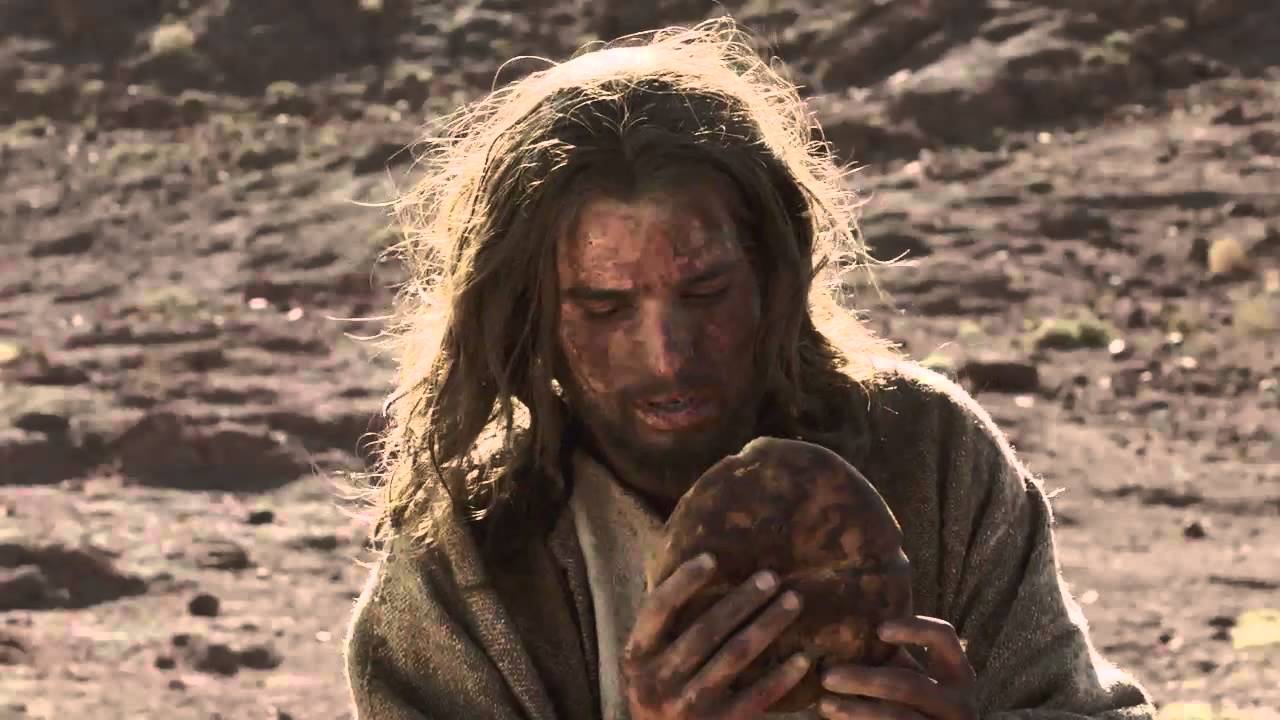
Image result for jesus in the desert
PC: Youtube video "Jesus Temptation in  Desert"
That face that this actor is making right there? Yeah, that's basically how I looked at my dinner at our Catholic Campus Ministry (CCM) dinner on Ash Wednesday after fasting that whole day. If I could only have one full meal that day, I was going to take advantage of that fish fry that we had that night!! I'll admit: By the time my 3:30 class rolled around, I was getting hungry, and watching my classmates eat their snacks during a film did not help at all. I was pretty much tempted to say, "Screw it," go to a vending machine, and pull the line from our Responsorial Psalm from this week: "Be merciful, O Lord, for [I] have sinned."

But our Lord couldn't do the same thing that I wanted to do. Well, I suppose He could have, if Satan is going to dare him to do it ("...command that these stones become loaves of bread."). But the point is that He didn't; instead, the Lord chose to slave through ALL forty days--as opposed to just one--and suffer....suffer like He did on the way to Calvary, which we'll be celebrating in a little over a month. 

We call Jesus "the new Adam." When I was little, I always wondered how we could just give God this human title. However, this week's readings clearly illustrate just why this title is given to Jesus: It's not a title, but, rather, a juxtaposition. According to Genesis as seen in our first reading, Adam did what I wanted to do on Wednesday: He wanted to eat. It looked good, and God made it sound good; therefore, it must be good! ....right?

Well, if you were a Roman asking St. Paul, he'd say no....in fact, St. Paul pretty obviously says, "He screwed us over." What makes me paraphrase it that way? Well, I don't know about you, but "death [coming] to all men" probably isn't a good thing.

Continuing on with St. Paul, even if there was someone who did not sin since Adam, that person could not save humanity. Much like a specific person messed up, a specific person is needed to make it up: Jesus Christ. 

The juxtaposition between Christ and Adam is this: For St. Paul, Adam was disobedient, which messed everyone up, but Christ was the opposite of Adam, and thus, through His obedience, saved everyone. 

Mary, as the new Eve, can be seen in a similar light: Eve, speaking to Satan, hesitated at first and then said, "Yes,"  to Satan; our Blessed Mother, speaking to the Lord through Gabriel, did not hesitate at all with her fiat ("yes"). Eve's "yes" doomed the whole human race, while Mary's "yes" saved it. 

What do all of these things have to do with us? I think the secret lies within our responsorial psalm. (That's right, the one part of the Mass we probably chill through.) How? Our Lord and Lady saving us is all fine and dandy, but why ought we still say, "Be merciful, O Lord?" 

For as long as I want to pull an Adam and disobey God, I'm going to have to pray this psalm, and I think that applies to all of us. So, by Sunday, we'll be 5 days into Lent, and even though Sundays don't count, I hope that we're not banking on Sunday to go nuts with whatever we gave up. 

Pope St. Leo the Great wanted people to not just give up on food and drink for Lent, but completely renounce sin. And I think it is fair to say that the Lord would want the same thing. Therefore, let's do that: If you've messed up already in these last few days, keep trying; if you're doing well, keep doing well; if you think your "challenge" is too easy (or you picked it because it was easy), then go deeper. This is the season to do that. This is the season to say, "Be merciful, O Lord," and, from there, stray no more. By doing this, we can hope the devil can leave us alone and then to be attended by angels. 

Friday, March 3, 2017

Introductions

Hello!


My name is Kevin Tran, and I am a junior at the University of North Carolina at Charlotte. I am double majoring in philosophy and religious studies, and, with these majors, I hope to continue my education until I am hopefully a doctoral student in theology. But the rest is by the grace of God. 
Speaking of which....

Purpose

I am Roman Catholic, and I made this blog for my Lenten experience this year in the hopes of bettering my prayer life. This blog will be my medium to reflect on Sunday Mass readings, and I hope to share these with you all. My two disclaimers for this blog are: 
  1. This blog is for my own personal reflections, and, thus, are my interpretations and/or reactions to the readings for the week. As such, I hope to be able to speak freely on this blog about my own personal feelings, so if it starts getting mushy (which I don't plan on that happening, but should it happen), that's why. 
  2. I do not claim any kind of Church authority. While many of my friends know that I am praying about my vocation, I'm no clergy, so don't be going around saying, "Well, Kevin wrote this and that." Should I happen to be completely wrong and you spot it, please correct me; I am always willing to learn more about the faith and what she teaches.

Meaning Behind the Title

The title of this blog is Caritas Christi Urget Nos. This title is inspired by my local bishop's motto, which, I'm sure, is derived from 2 Corinthians 5:14, which says, "The love of Christ impels us, once we have come to the conviction that one died for all; therefore, all have died." To focus on the first half, I believe that Christ's love did urge me to start this: For a personal benefit, my desire to fall deeper in love with Christ and Holy Mother Church led to my doing this, and, for those whom I share these blogs with, I hope that my reflections urge you all to do something similar to develop/maintain your own relationships with Christ. 
I hope this Lenten season urges you into deeper prayer, and, as Pope St. Leo the Great wrote, that whatever you chose to abstain from helps you to renounce sin and propel you into the Easter season, the source of our joy. I also hope that the habits you and I develop in these next 38 days will live on everyday, inspiring a symbolic daily baptism. 
I hope that the love of Christ urges you as it urges me.
"The grace of our Lord Jesus Christ and the love of God and the fellowship of the Holy Spirit be with you all." (2 Cor 13:13)